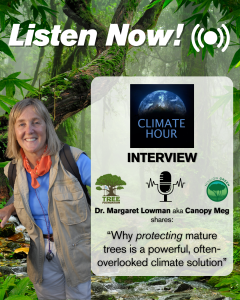
Dr. Lowman’s latest Nature’s Secrets column in newsobserver.com:
As a child, I never dreamed that someday I would buy a bottle of water in an airport. What commodities will be marketed next? Fresh air? Aerated soil?
Natural products obtained without monetary costs from healthy ecosystems are part of a bountiful harvest called natural capital or ecosystem services. It includes resources (air, water, fish, oil, minerals, etc) as well as living systems (coral reefs, wetlands, rain forests, etc).
An amazing feature of ecosystem services is that they function while we sleep: Streams purify water by flowing over rocky surfaces; earthworms aerate our soils without the use of fossil fuels and heavy machinery; forests produce oxygen, medicines and energy from sunlight. Even more amazing is the fact that these ecosystem services are free – but only if we leave portions of the landscape alone to function naturally.
RALEIGH, N.C. — Budding young scientists will soon have something new to explore in Raleigh – the new Nature Research Center (NRC).
The center makes up the new wing of the North Carolina Museum of Natural Sciences. It’s been a decade in the planning and two years under construction.
Dr. Meg Lowman, director of the Nature Research Center at the N.C. Museum of Natural Sciences in Raleigh, will be the guest speaker for the College of Arts and Sciences and University College commencement. Lowman pioneered the science of tree canopy ecology. Ceremonies will begin at 4 p.m. May 12 in the Holmes Convocation Center.
Nature never sleeps, so the North Carolina Museum of Natural Sciences, in Raleigh, will open its new wing, the Nature Research Center (NRC), with a 24-hour grand opening beginning at 5 p.m. on Friday, April 20.
This celebration is expected to attract 50,000 visitors and capture global imagination, national recognition and local attention, while maintaining a commitment to environmental sustainability.
The 80,000-square-foot expansion includes several green features, including LED lights from CREE, a green roof to reduce runoff, water collection in cisterns, and photovoltaic panels.
Invitees include Gov. Bev Perdue, legislative leaders, NRC supporters, visionaries in sustainability, and “rock stars” in science like Mark Moffett, Jane Goodall and Paul Rose.
To prepare for the grand opening of the new wing, the museum is closed until 5 p.m. April 20.
As a child, I loved the natural world. Maybe it had something to do with growing up in a small town where there were no distractions of big-city lights. Maybe the change of seasons with its foliage colors seduced me. Maybe it was because nature had so many secrets and I was thrilled at being a detective, uncovering them one by one. My neighbor, Betsy Hilfiger, and I built a tree fort, carving out rooms within the foliage and accompanying secret passageways among the tall grasses below, that fueled our imaginations as well as our love of nature. We collected wild flowers instead of Barbie dolls. We put Band-Aids on earthworms that inadvertently went through our dads’ lawnmowers. We diligently rescued baby birds fallen from their nests. Betsy’s older brother, Tommy, collected Beatles records, while Betsy and I collected beetles. He went on to design clothes, and I went on to study science. In retrospect, I occasionally realize that Tommy can literally buy an entire rain forest while I am trying to save it. Our lifelong journeys took unpredictable twists and turns from our childhood in Elmira, N.Y., but we both shared passion for our respective pursuits.
Several decades later, I passionately seek to inspire the next generation of scientists. As we look to solutions for global problems, STEM education (science, technology, engineering and mathematics) pays the bills. Science education for our kids links to national security, economy and health. To date, North Carolina is the first state in the country to creatively leverage its limited education funds in a transformational way. On April 20, a new model for North Carolina science education will be launched in Raleigh. Called the Nature Research Center, its iconic Daily Planet Theater (yes, named after Superman!) has the capability to broadcast cutting-edge science to all classrooms around the state.
What do Superman and science education in North Carolina have in common? Both science and Superman depend upon finding the truth to solve global challenges. Like the secret life of Superman disguised as newspaper reporter Clark Kent, the Nature Research Center (NRC) will inspire kids to become detectives about the scientific questions that affect their daily lives.
Margaret Lowman’s office is the top of a tree. It’s not her only one – she also has a office with a desk at the Nature Research Center, where she serves as director. But her job is different from most museum-director positions, in that she’ll do a lot of it out in the treetop canopy. Her nickname is “Canopy Meg,” after all. It’s a title Lowman earned because she may not be the Lorax, but she does speak for the trees.
“Yes, I’m Mother Nature,” Lowman quipped. “But I’m very honored to head up the Nature Research Center. This is a global first, not just a local one. There’s never been such a dedicated space for science that combines research and communication all under one roof.”
Scientific research will be a priority at the Nature Research Center, the N.C. Museum of Natural Science’s $56 million expansion, which has its public grand opening on April 20. But another part of the NRC’s mission is communicating about science – to explain the “how” as well as the “what” behind scientific research and discoveries.
“Raleigh’s New World” highlights 24 Days of Deals and a Trip to the Amazon in celebration of the opening of The Nature Research Center, an innovative 80,000-square-foot wing of the North Carolina Museum of Natural Sciences. This new museum will bring research scientists and their work into the public eye. The 24-hour opening celebration begins at 5:00 p.m. on April 20, 2012.
RALEIGH, NC – Although it’s personal day job news, I’m certain this announcement will be of interest to all of our PLoS readers and others in the science communications community.